

Reviewed · TRAIN STREET EXPERIENCES
Half Day trip to Incense & Hat Villages with Train Street
Hanoi’s craft villages offer something the city center cannot: the smell of incense, the steady work of village families, and a close look at how a famous Vietnamese hat takes shape. This half-day outing combines Chuong’s conical hats with Quang Phu Cau’s colorful incense bundles, then gives you the option of ending near Train Street.
I like the chance to meet working artisans rather than simply browse a souvenir shop, and I like that every participant receives a conical hat and water. The main catch is the price: the advertised $12 does not include the bus transfer, and round-trip pickup from Hanoi’s Old Quarter costs extra. Check the final total before booking.
In This Review
- Key points at a glance
- Why these two villages make a good Hanoi side trip
- Chuong village and the making of a conical hat
- Quang Phu Cau, where incense fills the village
- Inside the larger incense factory
- The ride from Hanoi and the real timing
- Train Street as the final stop
- Guides, group size, and the human side
- Food, weather, and what to bring
- What the $12 price really means
- Who should book this half-day outing
- Should you book it?
- FAQ
- How long does the tour last?
- What villages does the tour visit?
- Is transportation included in the $12 price?
- Is lunch included?
- Is Train Street part of the guided itinerary?
- What is included in the tour?
- What happens if it rains?
Key points at a glance
- Chuong village’s 300-year hat tradition: Watch artisans shape the iconic Vietnamese conical hat by hand.
- Quang Phu Cau’s incense work: See incense from raw materials through drying, dyeing, and packing.
- Colorful photo stop: A specialist household displays dyed incense sticks in eye-catching bundles.
- Small English-speaking group: The tour is limited to 15 people, with guides including Chris and Vu.
- Train Street finish: You can be dropped at the famous railway street or another agreed location.
- No meal included: Eat before leaving or pack a snack, especially for the afternoon departure.
Why these two villages make a good Hanoi side trip

Hanoi is easy to enjoy from a café or the Old Quarter pavement. It is harder to see the work that supports daily life beyond the city. This trip helps with that. You travel to villages where traditional craft is still part of the local economy, not just a staged display for tourists.
The two stops also contrast nicely. Chuong focuses on one familiar object, the conical hat. Quang Phu Cau gives you a fuller production story, with incense sticks prepared, colored, dried, and finished in several stages.
I find this pairing more useful than a single craft visit because you get both a quiet, hand-built product and a larger working operation. The first stop helps you understand patience and precision. The second shows how a village craft can involve many households and different jobs.
The experience is not a luxury excursion. It is a practical, low-cost introduction to rural craft life, with transport, entrance fees, a hat, and water included in the base arrangements. Just keep the extra transfer charge firmly in mind.
More Train Street visits:
- Hanoi: Guided Food Tour with Train Street Visit
★ 4.9 · 6,239 reviews - Hanoi: Street Food Tour with Train Street & Hidden Alleyways
★ 5.0 · 2,831 reviews - Hanoi: Guided Street Food Tour with Train Street Experience
★ 4.9 · 2,479 reviews
Chuong village and the making of a conical hat
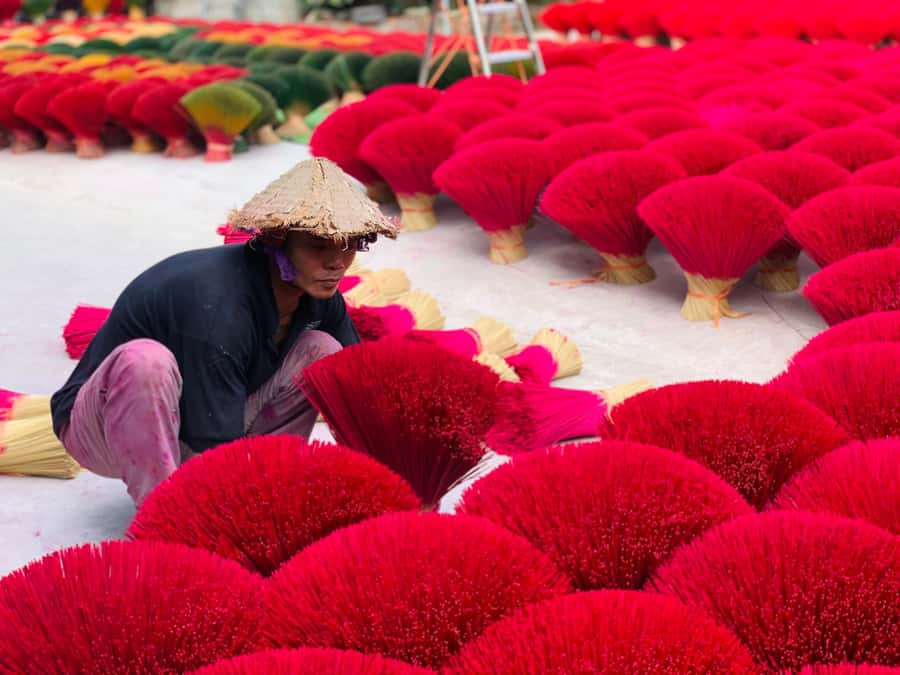
The first village is Chuong, known for a 300-year tradition of conical hat making. The hat is one of Vietnam’s most recognizable cultural symbols, but seeing one completed in a shop tells you little about the work behind it.
Here, you meet a local artisan and watch the hat-making process. The supplied information does not promise that you will make a hat yourself, so think of this as a demonstration and working-village visit rather than a hands-on workshop.
The included conical hat is a practical touch. It gives you a tangible reminder of the stop and adds value to the low base price. It also means you do not need to buy one on the spot simply to take something home.
You have about one hour at Chuong. That is enough for an introduction and a look at the craft, but not a long, slow study of every stage. If hats interest you, use your time well. Watch how the artisan handles the materials, note the repeated steps, and ask the guide to explain anything that is unclear.
This stop may appeal most to you if you prefer traditional skills and personal contact over a large factory setting. It is also the shorter village visit, so the tour moves on before the hat-making story has time to become repetitive.
Quang Phu Cau, where incense fills the village
Quang Phu Cau is the main event, with about two hours set aside for the visit. The village has a century-old incense craft tradition, and production takes place on a small household scale as well as in a larger factory.
The first impression is likely to come through your senses. Incense brings a distinct scent, and the work creates a village atmosphere quite different from Hanoi’s streets. The tour description specifically highlights the sights, sounds, and smells of the craft, so this is not only a photo stop.
You walk through the village center and see families working on incense production. That matters because it puts the finished product in context. Instead of seeing only neat packages in a shop, you see the people and steps behind them.
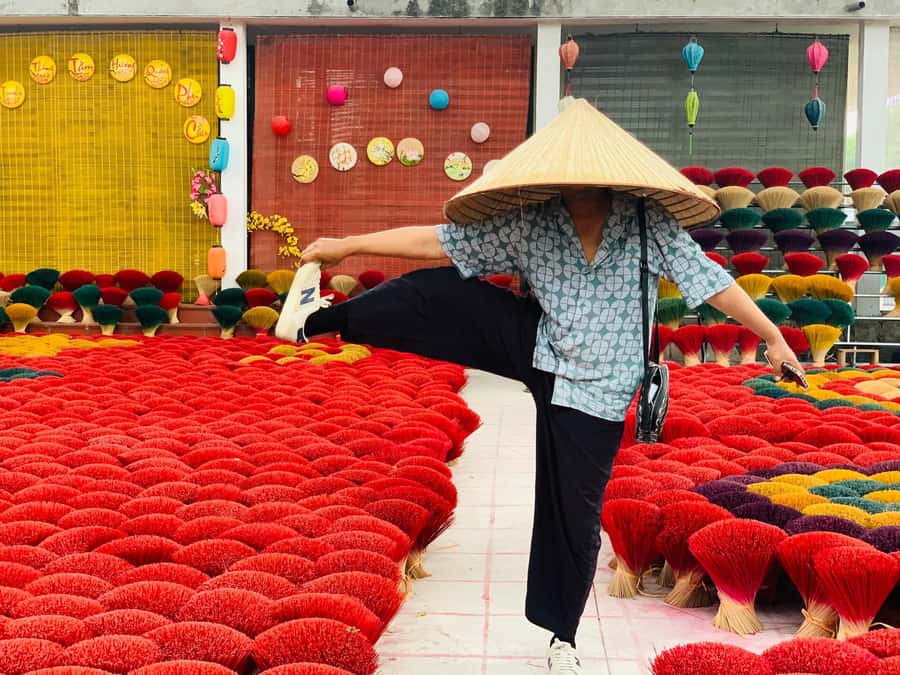
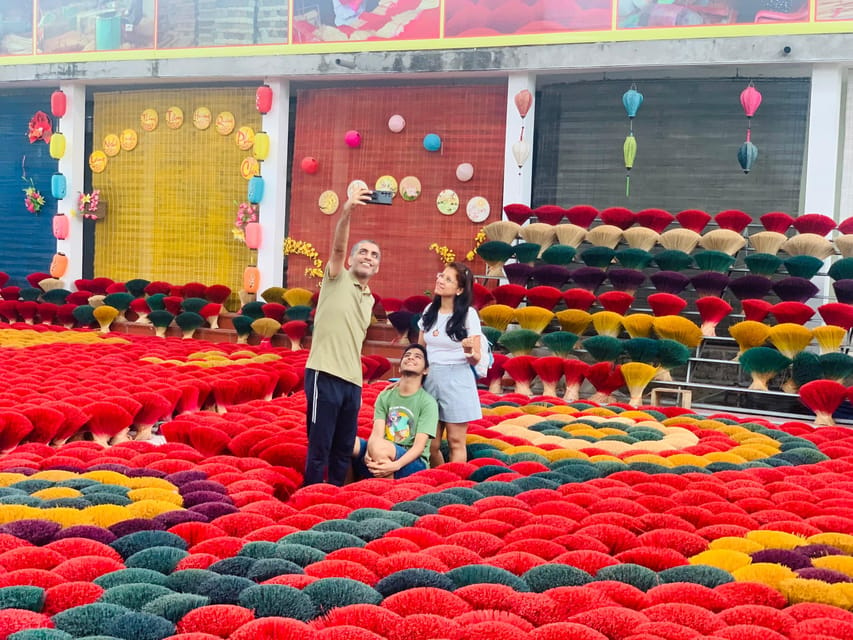
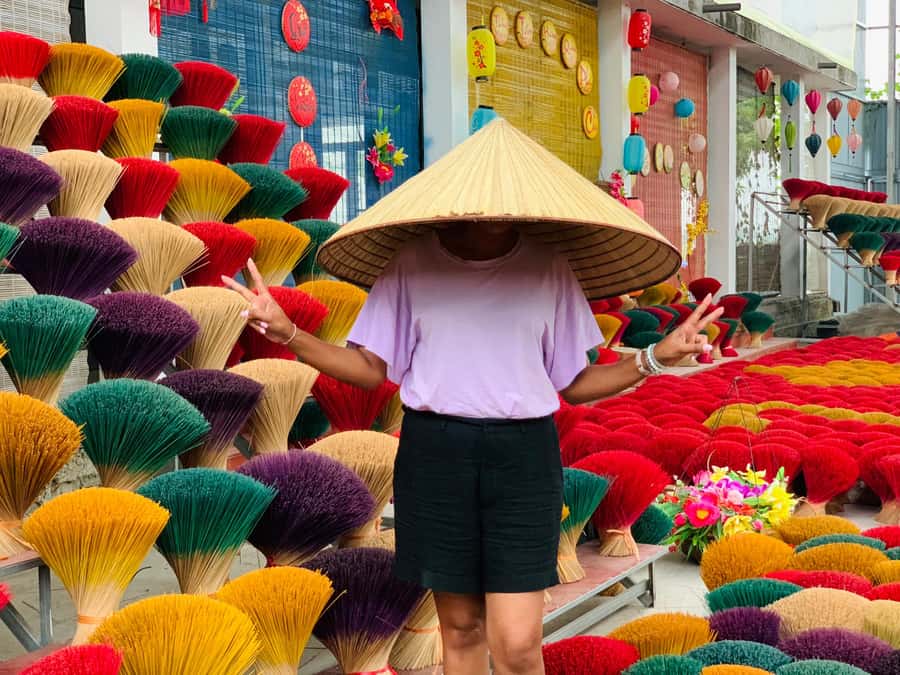
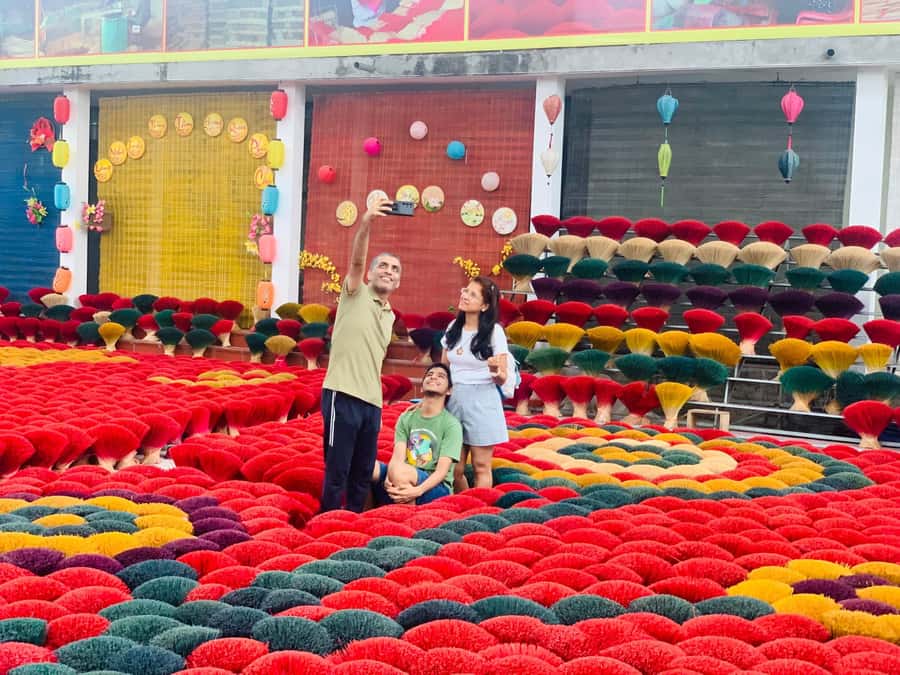
The visit includes a specialist household that dyes incense sticks. This is the most obvious photo opportunity. Bundles of colored sticks are arranged for drying and display, creating strong patterns for your camera.
I would bring a camera, but I would also spend time looking past the photo. The value of Quang Phu Cau is the combination of image and process. Ask the English-speaking guide to explain what happens before and after the dyeing stage. The guide’s explanation can turn a pretty picture into a better understanding of village work.
Inside the larger incense factory

The tour finishes its village portion at Quang Phu Cau’s largest incense factory. This gives you a wider view than the household visit. You can see the full chain from raw materials to finished products and learn more about the lives of rural workers.
The word largest should not make you expect a giant industrial complex. The information provided describes a factory visit within the village setting, alongside small-scale family production. The useful point is that you see a more organized operation after seeing household work.
This is also where the tour has its strongest educational value. You can compare the work done by individual families with the steps handled at a larger production site. The visit helps explain why incense remains an important village craft and how different workers contribute to the final product.
The tour does not include a lacquer-making experience. A lacquer piece is listed as an extra cost for anyone who chooses that craft activity, so do not assume it is part of this package. If someone offers it during the day, ask about the price first.
More craft village visits from Hanoi:
- Incense Village, Hat Making & Lacquer Artisan Small Group Hanoi
★ 5.0 · 1,266 reviews - Incense Village, Conical Hat, Lacquer Art, SMALL GROUP From Hanoi
★ 5.0 · 1,170 reviews - Hanoi: Incense Village, Hat, and Lacquer Artisanal Tour
★ 4.6 · 1,005 reviews - Incense Village Small Group of 9 Tour From Hanoi to Ninh Binh
★ 5.0 · 626 reviews
The ride from Hanoi and the real timing

The outing lasts about five hours according to the main description. The schedule offers a morning departure from about 7:30 a.m. to noon, or an afternoon departure from noon to 5 p.m. Exact starting times depend on availability.
The listed travel time is about 70 minutes on the way out and 1.5 hours on the return. The village visits are listed as two hours at Quang Phu Cau and one hour at Chuong. Added together, those estimates can run beyond five hours, before traffic or pickup delays.
That does not make the tour poor value, but it does mean you should avoid booking a tight appointment afterward. Hanoi traffic can affect the return, and the published time blocks leave little room for surprises.
Pickup is available from accommodation in Hanoi’s Old Quarter, with the stated pickup window from 12:00 p.m. to 12:30 p.m. for the afternoon option. If you stay outside the Old Quarter, you meet at 87 Ma May Street in Hoan Kiem.
The transport arrangement needs careful attention. Pickup and drop-off inside the Old Quarter carry an extra fee, listed as 350,000 Vietnamese dong per person for round-trip transfer. The inclusions also list a $15, or 375,000 dong, bus-transfer charge for the half-day trip.
Those figures are not identical. I would ask the provider to confirm the exact transfer cost, what it covers, and whether the charge applies to your chosen pickup arrangement. The $12 headline price is attractive, but your final cost may be closer to the base price plus transport.
Train Street as the final stop
The outing concludes with a return to Hanoi and the option of being dropped at Train Street or another location of your choice. This is useful if you want to continue sightseeing instead of returning directly to your accommodation.
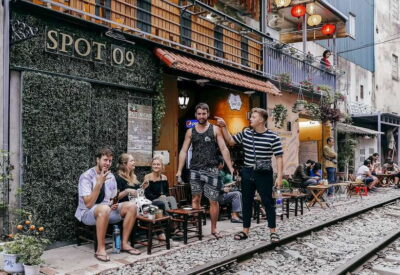
You should understand the wording carefully. Train Street is described as a drop-off option at the end, not as a fully explained guided visit with a guaranteed train passage. The overview says you can sit back as the train runs through the narrow street, but the practical details focus on the final drop-off.
For that reason, ask the operator how much time is allowed at Train Street and whether the drop-off is timed around a train. Do not build your entire Hanoi evening around seeing a train unless the schedule is confirmed.
Still, the location makes sense as a finish. After a rural craft visit, you return to one of Hanoi’s most talked-about urban sights. It also gives you flexibility. You can choose Train Street, return to Hoan Kiem, or request another available location.
Guides, group size, and the human side
The tour uses an English-speaking live guide and limits the group to 15 participants. That is small enough for a more personal explanation than you usually get on a large coach, though it is not a private tour.
Guide quality matters here. Chris is described as friendly and well informed, and Vu is praised for being friendly and helpful. Another assessment notes that the guide was well prepared and explained many points clearly. Those details are worth considering because the craft visits depend on explanation. Without a guide, you might see hats and incense but miss the meaning of the work.
The provider is Lisa Vietnam Travel. Your exact guide may not be Chris or Vu, so treat those names as examples rather than a promise. Still, the praise for preparation, clear explanations, and a helpful manner points to the right qualities to expect from the guiding team.
You should also expect a working village rather than a polished museum. That can mean a more genuine view of production, but it may also feel less orderly. The experience is best approached with curiosity and respect for people who are working, not performing a show every minute.
Food, weather, and what to bring
Lunch is not included. The morning schedule finishes around noon, while the afternoon option runs from around noon to 5 p.m. If you take the afternoon tour, eat beforehand or bring a snack.
A water bottle is included for each person, but other drinks are not. The supplied advice is simple: bring a camera and wear clothing suited to the weather.
The activity runs rain or shine. Vietnam’s weather can change, and village visits involve time outside, so dress for the forecast rather than for Hanoi’s indoor cafés. Comfortable clothing is more useful than anything formal.
Incense can be a strong sensory experience. If you are sensitive to smoke or scent, keep that in mind before booking. The supplied details do not state how much smoke you will encounter, so you may want to ask the operator if this is a concern.
What the $12 price really means

At $12 per person, the base offer looks like an easy addition to a Hanoi stay. Entrance fees, a conical hat, and water are included, which helps the value. You are also paying for an English-speaking guide and access to two craft villages.
The transport charge changes the calculation. Bus transfer is excluded, and Old Quarter pickup costs extra. Holiday dates also carry a $10 fee during Christmas, New Year, and Lunar Tet.
I would judge this tour on the final confirmed price, not the headline figure. It can still be good value if you want two villages, guided explanations, and a small group without arranging separate transport. It is less compelling if you already have a driver, dislike fixed schedules, or mainly want a short photo stop.
Tips for the guide and driver are not included. They are optional, but you should budget for them if you feel the service was helpful.
Cancellation is flexible: you can cancel up to 24 hours ahead for a full refund, and you can reserve now and pay later. Those terms are useful when your Hanoi plans are still shifting.
Who should book this half-day outing
I would recommend it to you if you want to see traditional production outside Hanoi without committing to a full-day trip. It suits first-time visitors who want a cultural experience that is easy to fit around time in the Old Quarter.
It is also a good match for photographers. The dyed incense bundles offer the clearest visual payoff, while the conical hat visit adds cultural context and a useful souvenir.
Families may appreciate the short format and the included hat, though the tour is still a working craft visit rather than a children’s activity program. The lack of lunch keeps the schedule short but means you must plan food.
You may want to skip it if you need a fully private experience, guaranteed free time at Train Street, or a hands-on craft class. The lacquer activity is not included, and the hat visit is observational rather than a confirmed make-your-own session.
Should you book it?
Book this tour if you want a compact introduction to Hanoi’s craft villages and like the idea of meeting artisans, seeing incense production at several levels, and ending near Train Street. The strongest parts are the two-hour Quang Phu Cau visit, the dyeing household, and the clear guidance provided by people such as Chris and Vu.
Before paying, confirm the transfer fee and your exact pickup point. Eat first or pack a snack, allow extra time for the return drive, and ask how the Train Street drop-off works on your date. With those details settled, this is a useful, affordable side trip for seeing a working part of Vietnam beyond the city center.
FAQ
How long does the tour last?
The advertised duration is about five hours. The morning schedule runs from around 7:30 a.m. to noon, and the afternoon schedule runs from around noon to 5 p.m. Listed travel and visit times can add up to longer, so leave some flexibility.
What villages does the tour visit?
The tour visits Chuong Conical Hat Village and Quang Phu Cau Incense Village.
Is transportation included in the $12 price?
Bus transfer is listed as an extra charge of $15, or 375,000 Vietnamese dong, for the half-day tour. Old Quarter pickup and drop-off also carry an extra fee, listed as 350,000 dong per person for round-trip transfer. Confirm the exact amount when booking.
Is lunch included?
No. You should eat before the tour or bring snacks, particularly for the afternoon departure.
Is Train Street part of the guided itinerary?
The tour ends with the option to be dropped at Train Street or another location. The supplied details do not guarantee a specific train passage or a set amount of time there, so confirm those details with the provider.
What is included in the tour?
The package includes planned entrance fees, one conical hat per person, and one bottle of water per person. Drinks, bus transfer, tips, and any lacquer piece are not included.
What happens if it rains?
The activity operates rain or shine. Bring a camera and wear clothing suitable for the weather.
More 1-Day Tours in Hanoi
- Hanoi/Ninh Binh: 1-Day Tam Coc/Trang An, Hoa Lu & Mua Caves
★ 4.6 · 3,706 reviews - Full day trip to Lan Ha-Ha Long Bay from Cat Ba, avoid the crowds
★ 5.0 · 3,317 reviews - Ninh Binh Day Trip: Hoa Lu-Trang An/Tam Coc-Mua Cave-Cycling-Boat
★ 5.0 · 1,886 reviews - Ninh Binh Day Trip: Bai Dinh-Trang An-Mua Cave, Buffet, Boat, Bus
★ 5.0 · 1,183 reviews
Just added around Hanoi
- Cat Ba National Park, Lan Ha Bay 2 Days 1 Night Adventure★ 4.8 · 9 reviews
- Full day Boat Tour Lan Ha Bay – Ha Long Bay: Kayak, Beach Hopping★ 5.0 · 9 reviews
- Ha Giang Loop 2 Days High quality Small Group +Private Room★ 5.0 · 9 reviews
- Half Day Sapa Cat Cat Explore Waterfall, Workshop, H’mong Local★ 5.0 · 9 reviews
- Sapa 1 Day Trekking★ 5.0 · 9 reviews
- Sapa Open Air Jeep Half Days Off the Beaten Track, Backroad★ 4.9 · 9 reviews
- Halong 2 days 1 night with Cozy Classic Cruise from Hanoi★ 4.5 · 9 reviews
- Fansipan Mount Trekking 1 Day★ 5.0 · 9 reviews
Train Street Experiences, compared.
Street Food Tour with Train Street & Hidden Alleyways
Read our review →
Guided Street Food Tour with Train Street Experience
Read our review →
Hanoi City Tour Highlight, Train Street Combine visit Countryside
Read our review →
Hanoi Jeep City Highlight, Backstreet, Train Street, Countryside
Read our review →
Guided Hanoi Food Tour With Train Street 8 Different Food Tasting
Read our review →
Walking Street Food Tour in Hanoi and Train Street
Read our review →Browse the lists this tour appears in